meta

1. Introduction: why becoming a VA in 2026 is a smart move

Business owner evaluating virtual assistant candidates on laptop focusing on trust and reliability

There’s a quiet shift happening in how people work. Offices are optional. Teams are global. And more businesses are being run from laptops than ever before.

Right in the middle of that shift sits the virtual assistant.

Not as a side role. Not as “just admin.” But as the operational backbone of modern, online businesses.

In 2026, becoming a VA isn’t about answering emails all day. It’s about helping founders move faster, stay organised, and keep their business running without friction. And the best part? You don’t need a degree, years of experience, or a perfect plan to get started.

You just need to be useful.

This guide will walk you through exactly how to go from complete beginner to your first paid VA client – step by step, without the fluff.

2. What is a virtual assistant (and what do they actually do?)

What is a virtual assistant (and what do they actually do)

At its simplest, a virtual assistant is someone who supports a business remotely.

But that definition doesn’t quite capture the reality of the role anymore.

A modern VA is part organiser, part problem-solver, part systems thinker. You’re the person who keeps things from slipping through the cracks.

On a practical level, that might look like:

  • Managing inboxes so nothing important gets missed
  • Scheduling meetings and keeping calendars under control
  • Handling customer queries or support messages
  • Organising files, data, and internal systems
  • Supporting content, social media, or research tasks

But here’s the 2026 shift: clients don’t just want tasks done, they want things to run smoothly.

That means VAs are increasingly expected to:

  • Set up simple workflows
  • Suggest better ways of doing things
  • Use tools (and even AI) to save time

You’re not just helping. You’re reducing friction.

3. Why virtual assistance is still one of the best beginner careers
Beginner virtual assistant starting an online remote work career

For all the talk about AI replacing jobs, virtual assistance has quietly stayed one of the most accessible ways to start working online.

Because businesses don’t just need automation. They need people who can think.

Becoming a VA is beginner-friendly for a few key reasons:

You don’t need formal qualifications
If you can communicate clearly, stay organised, and use a computer, you already have a foundation.

You can start with what you already know
Most beginners begin with simple admin tasks and build from there.

It’s flexible by design
You can work part-time, full-time, freelance, or alongside another job.

It scales with you
You might start with inbox management, but over time, you can move into higher-value services, better clients, and higher rates.

For career changers, parents returning to work, students, or anyone wanting out of rigid 9–5 structures, it’s one of the most practical entry points into remote work.

4. The core skills you need to start (2026 edition)
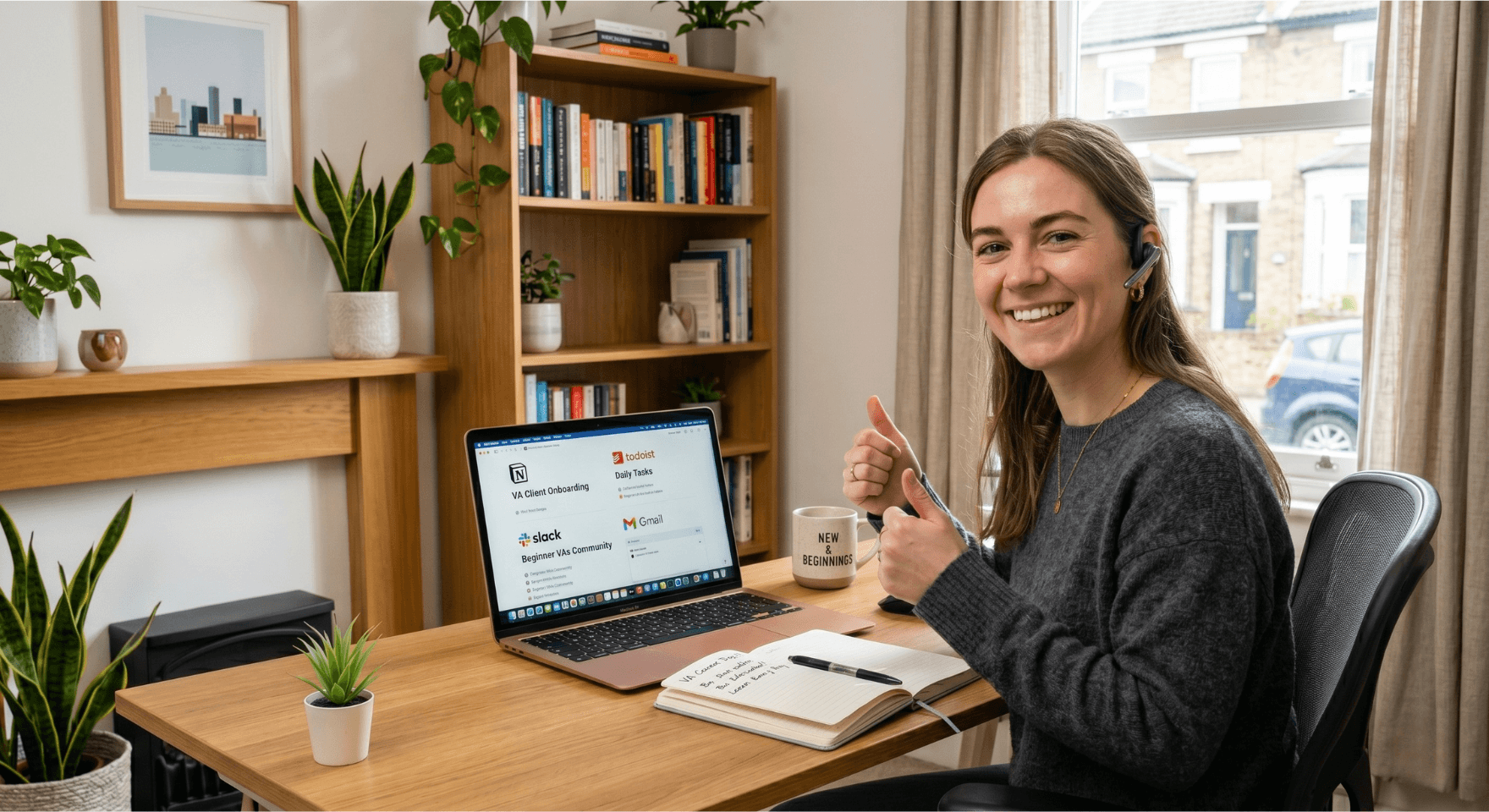
Virtual assistant using digital tools for organization and communication

There’s a misconception that you need to “learn everything” before becoming a VA.

You don’t.

You need a small set of skills that make you immediately useful.

4.1 Soft skills (the real differentiators)

These are what actually get you hired – and kept.

  • Clear communication – Clients need to understand you instantly
  • Organisation – You’re managing moving parts, not just tasks
  • Time management – Deadlines matter
  • Reliability – Doing what you said you would do, consistently
  • Problem-solving – Figuring things out without constant direction

You can learn tools quickly. These skills are what make clients trust you.

4.2 Practical digital skills

This is your toolkit – the things clients expect you to know (or learn fast):

  • Google Workspace (Docs, Sheets, Drive, Calendar)
  • Project tools like Trello, Asana, or ClickUp
  • Scheduling tools like Calendly
  • Basic familiarity with CRMs or client systems

You don’t need to master every platform. You need to be comfortable learning them.

4.3 The 2026 upgrade: AI literacy

This is where the role is evolving.

You don’t need to become technical. But you do need to understand how to use AI tools to:

  • Draft and refine content
  • Summarise information
  • Organise data faster
  • Support workflows

The key difference? Good VAs don’t rely on AI blindly. They use it to move faster, while still applying judgment.

That combination is what makes you valuable.

5. Services you can offer as a beginner VA
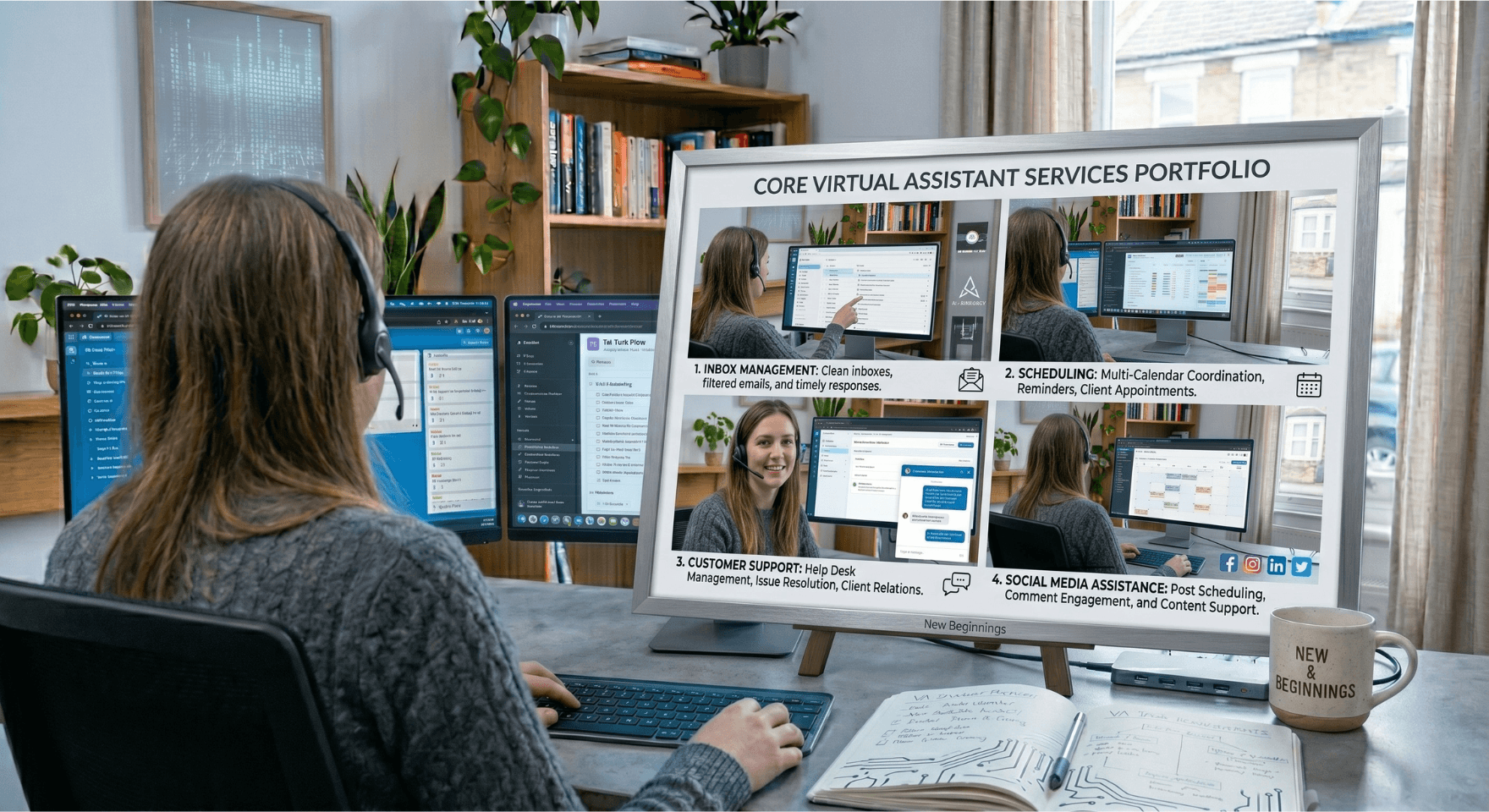
Common services offered by beginner virtual assistants

One of the biggest mistakes beginners make is trying to offer everything.

The fastest way to get hired is to keep it simple.

5.1 Start with clear, in-demand services

Focus on tasks businesses always need help with:

  • Inbox and email management
  • Calendar scheduling
  • Data entry and organisation
  • Online research
  • Customer support
  • Basic content or social media assistance

These are easy to explain. Easy to trust. And easy for a client to say yes to.

5.2 Then expand over time

Once you’re confident, you can build on that foundation:

  • Email marketing support
  • CRM management
  • Project coordination
  • Executive assistant work

You don’t need to start specialised. You grow into it.

5.3 A smarter way to position yourself

Instead of saying:
“I’m a virtual assistant who does admin…”

Say something like:
“I help busy founders stay organised by managing their inbox, calendar, and daily operations.”

Same work. Completely different perception.

Clarity sells.

6. Step-by-step: how to become a VA in 2026 (part 1)

The path isn’t complicated, but it does require action.

Step 1: Learn the basics and choose your starting point

Understand what VAs do and decide which services you can realistically offer first.

Step 2: Get comfortable with core tools

You don’t need mastery – just enough familiarity to complete real tasks confidently.

Step 3: Practice before you get paid

Create sample work:

  • Organise a mock inbox
  • Build a simple spreadsheet
  • Plan a content calendar

This is how you bridge the gap between “learning” and “doing.”
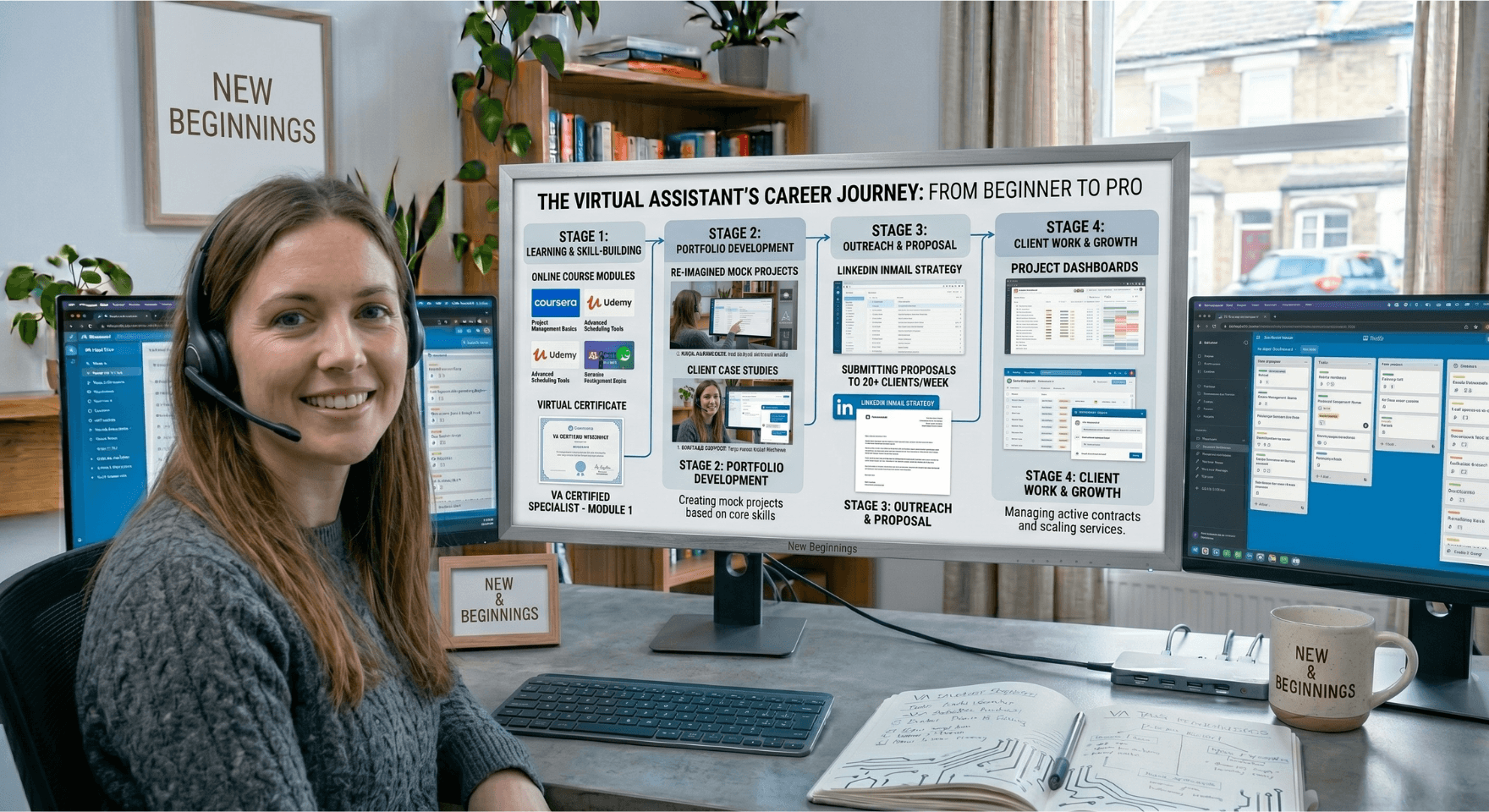
Roadmap showing the steps to become a virtual assistant in 2026

6. Step-by-step: how to become a VA in 2026 (part 2)

By now, you’ve built the foundation: you understand the role, you’ve chosen your core services, and you’ve practiced the basics.

Now comes the part that actually turns this into income.

Step 4: Build a simple portfolio

You don’t need clients to prove you can do the work.

You need proof that you understand the work.

A strong beginner portfolio might include:

  • A sample inbox organisation system (folders, labels, filters)
  • A clean, well-structured spreadsheet
  • A mock content calendar
  • A short case study: “Here’s how I would organise this business”

Keep it simple. Keep it clear. Focus on showing how you think.

Because clients aren’t just hiring skills – they’re hiring confidence.

Step 5: Create your online presence

This is where you position yourself as someone ready to be hired.

You don’t need a complicated website. You need:

  • A clear bio (who you help + how)
  • A simple list of services
  • A professional email address
  • A portfolio link or samples

Think of it less like a “brand” and more like a clear introduction.

If someone finds you, they should instantly understand what you do and who it’s for.

Step 6: Start reaching out (before you feel ready)

This is the step most people delay, and the one that matters most.

You do not need to feel confident. You need to start.

Begin with:

  • Freelance platforms
  • Job boards
  • Direct outreach to small businesses
  • Online communities where your ideal clients spend time

And keep your message simple:

“I help [type of client] with [specific problem] so they can [result].”

No long explanations. No overthinking.

Clarity gets replies.

Step 7: Learn while you earn

Your first client won’t expect perfection.

They expect reliability, communication, and effort.

As you start working:

  • You’ll get faster
  • You’ll understand real client needs
  • You’ll improve naturally

This is where real growth happens, not in courses, but in doing the work.

7. How to build a portfolio (even with no experience)

Sample virtual assistant portfolio showcasing organization and workflow skills

Let’s make this clear: you do not need paid experience to get started.

What you need is proof.

A beginner VA portfolio works when it shows:

  • You understand common tasks
  • You can organise information clearly
  • You can think through problems logically

Good examples include:

  • A Google Drive setup for a “client”
  • A weekly planning system
  • A mock onboarding workflow
  • A before-and-after example of organised data

Even helping a friend, a small business, or a personal project counts.

The goal isn’t perfection. It’s credibility.

8. Where to learn VA skills (without overcomplicating it)

Virtual assistant learning new remote work and productivity skills online

You don’t need a £1,000 course to start.

You need focused, practical learning.

Free Options

  • YouTube tutorials
  • Blog guides
  • Real-world walkthroughs of tools

Low-Cost Platforms

The Most Underrated Method

Learn by doing.

Open the tools. Test things. Break things. Fix them.

That’s how you actually become confident.

9. How to find your first clients

Business owner choosing a beginner virtual assistant for support

This is where most beginners overthink – and slow themselves down.

Getting your first client is less about being “the best” and more about being clear and consistent.

Start with:

  • People you already know
  • Small businesses or solo founders
  • Beginner-friendly job listings
  • Online communities

And focus on this one idea:

Clients don’t hire VAs. They hire solutions.

So instead of listing tasks, speak to outcomes:

  • “I’ll keep your inbox organised so nothing gets missed.”
  • “I’ll manage your calendar so your week runs smoothly.”

Simple. Specific. Useful.

Then repeat the process consistently.

That’s what creates momentum.

10. How much you can earn as a beginner VA

Virtual assistant tracking income growth and client projects

There’s no single number, and anyone who gives you one is oversimplifying.

Your income depends on:

  • Your skills
  • Your niche
  • Your confidence in selling your services
  • The type of clients you work with

Most beginners start modestly, then increase their rates as they:

  • Get faster
  • Build trust
  • Deliver better results

Over time, many VAs move away from hourly pricing and into:

  • Monthly retainers
  • Service packages

Because predictable income beats unpredictable hours.

11. Common mistakes to avoid
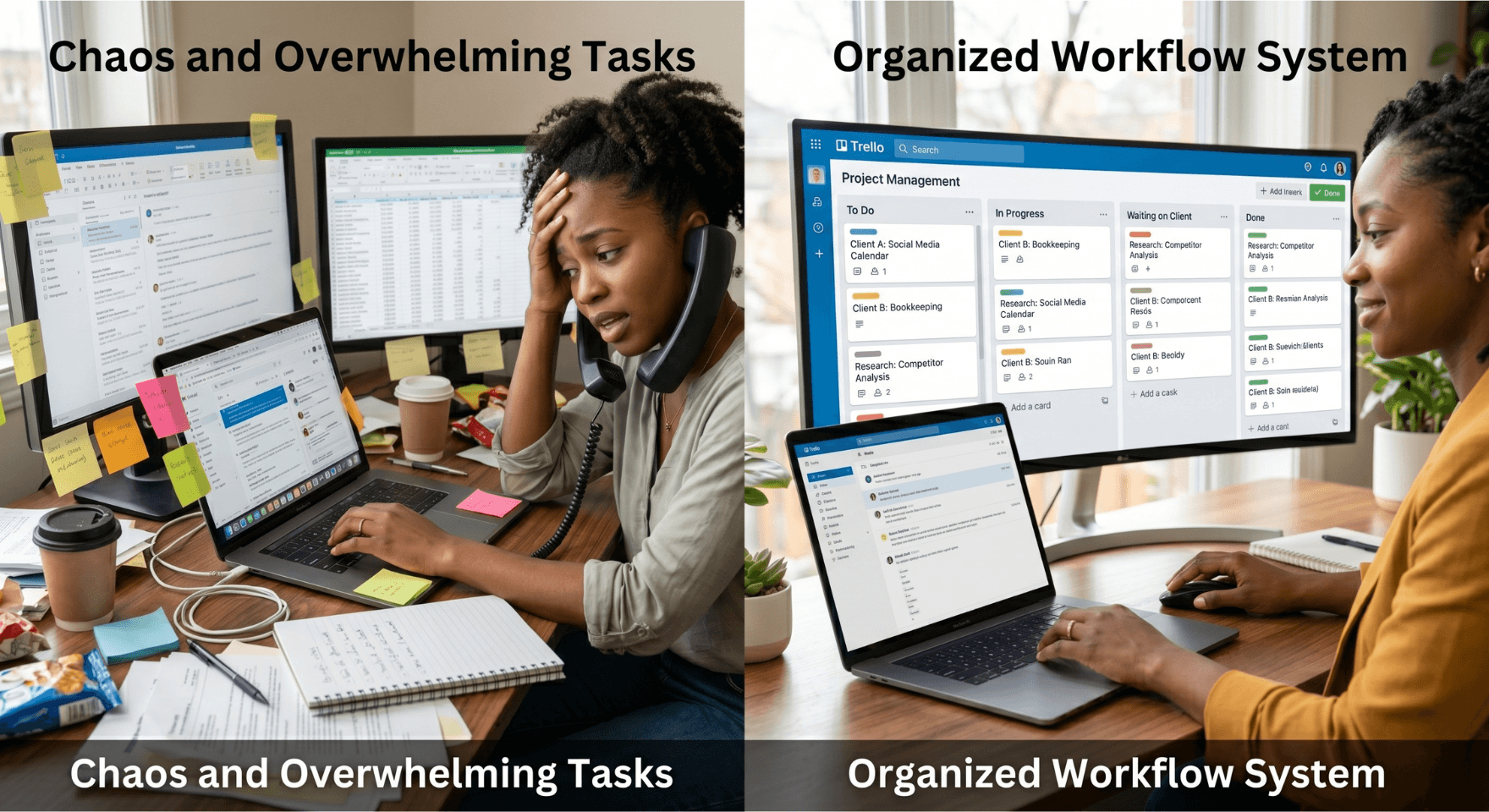
Beginner virtual assistant struggling with disorganization and workload

If you want to move faster, avoid these early traps:

Trying to do everything
You don’t need 10 services. You need 1–2 that you can do well.

Waiting until you feel “ready”
You’ll never feel fully ready. Action builds confidence.

Skipping a portfolio
Even basic proof is better than none.

Underpricing yourself long-term
Starting low is normal. Staying low is not.

Ignoring the tools clients actually use
Learn what’s relevant—not what’s trendy.

Avoiding AI and systems
In 2026, efficiency matters. The best VAs know how to work smart.

12. The real secret: focus beats everything

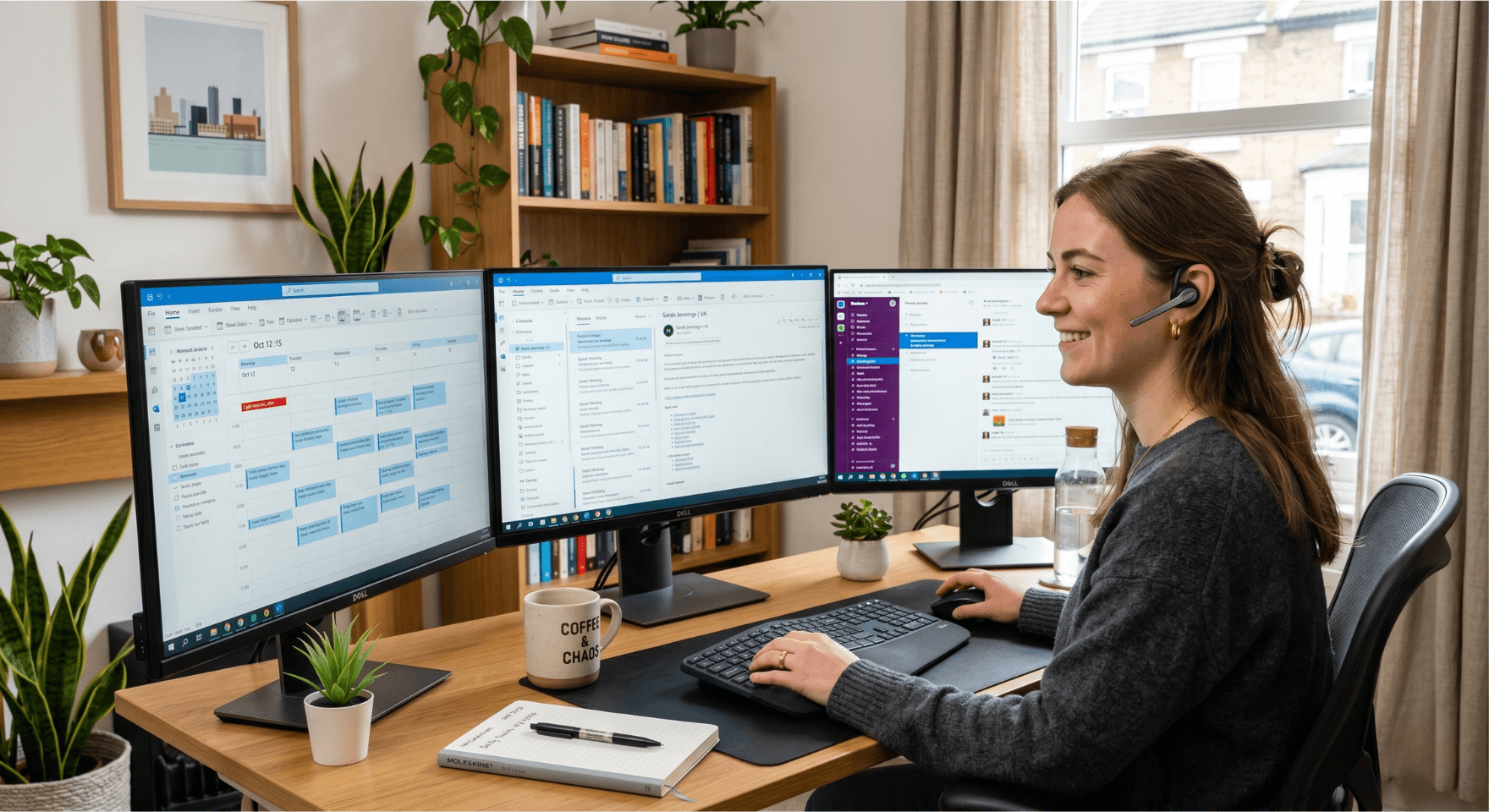
Focused virtual assistant working efficiently in organized workspace

If there’s one takeaway from this entire guide, it’s this:

The fastest way to become a virtual assistant is not to learn everything.

It’s to become useful – quickly.

Pick a small set of skills.
Learn the core tools.
Offer one clear service.
Start before you feel ready.

Everything else comes from experience.

13. Conclusion: start before you overthink it

Beginner virtual assistant starting a remote career from home

Becoming a virtual assistant in 2026 isn’t about having the perfect plan.

It’s about momentum.

You don’t need to know everything.
You don’t need years of experience.
You don’t need to wait.

You need to start.

Learn one skill.
Create one sample.
Send one message.

Because the difference between people who want to become a VA – and people who actually get paid – is simple:

One group waits.
The other begins.

Ready to hire a Virtual Assistant?

If you’re exploring virtual assistant agencies or need guidance on which model fits your business best – now is the time to take the next step.
Let’s find the right support for your workflow, growth, and peace of mind.

The right VA doesn’t just lighten your workload – they protect your momentum.

Why start from scratch when the right team is already trained and ready to plug into your workflow?

Get Started in 3 Easy Steps:

  1. Book a quick discovery call
  2. Tell us what your business needs
  3. Get matched with a trained VA – in days, not weeks

Let’s Build Your Support System

📩 Click here to schedule your consultation
📞 Prefer to talk? Contact us directly at 020 4586 6800

👉 Your next VA shouldn’t just save time – they should unlock growth.
Let’s make that happen. 🚀

FAQ: How to become a virtual assistant in 2026: the complete beginner guide

  1. Do I need experience to become a virtual assistant in 2026?
    No. Most beginners start without formal experience. What matters more is showing you can do the work. A simple portfolio with sample tasks – like inbox organisation, scheduling systems, or spreadsheets – can be enough to get your first client.
  2. How long does it take to get your first paying client?
    It depends on how quickly you take action. Some people land their first client within a few weeks by focusing on a small set of services and applying consistently. The biggest delay usually comes from waiting too long to start reaching out.
  3. What are the best skills to learn first as a beginner VA?
    Start with the basics that clients always need:
  • Email and inbox management
  • Calendar scheduling
  • Google Workspace (Docs, Sheets, Calendar)
  • Basic organisation and communication

Once you’re comfortable, you can expand into more specialised services.

  1. Do I need to learn AI to become a virtual assistant?
    You don’t need advanced technical knowledge, but basic AI literacy is becoming important. Knowing how to use AI tools to draft, organise, or speed up tasks can make you more efficient—and more valuable to clients.
  2. Can I become a virtual assistant part-time or as a side hustle?
    Yes. Many VAs start part-time alongside a job, studies, or other commitments. The role is flexible, so you can build experience and income gradually before deciding whether to go full-time.
Liked this post, share:

Facebook
Twitter
Pinterest
LinkedIn

Related Posts

Stay Ahead with Exclusive Tips from Advance Virtual Assistants!

Unlock productivity secrets, industry insights, and exclusive offers tailored for busy professionals. Sign up for our newsletter to get expert advice on maximizing your virtual assistant services and staying ahead in a competitive market—straight to your inbox!

Join VIP NOW

Only £19

Get access my VIP packages and top secretes to succeed in your VA Business

Mindset Reset

You may have heard us say….  Mindset Is EVERYTHING.  Working on having a positive, growth mindset is essential to your business success.

Who Is My Ideal Client?

Doing this work is very important.  We start our own business to create a life of FREEDOM.  So ensuring we work with people who inspire us and we love the work we do with them is essential.

Securing New Clients for Virtual Assistants

“This e-book is invaluable” – so we have been told. In here we walk you through the process that we used to build our business.

150 Services a Virtual Assistant Can Offer

That’s right – 150 services (and there are possibly more!)  This amazing list will help you to identify skills that you have that you could sell and may pique your interest in new skills that you’d like to offer.

Skills Analysis for Virtual Assistants

A comprehensive sheet that helps you to define the services that you would like to offer to your clients.

Virtual Assistant Starter Checklist​

A simple checklist to help you work through the steps to set up your Virtual Assistant business, avoiding endless Googling and overwhelm.

Advance Virtual Assistants Ltd
Website Privacy Notice

1.   INTRODUCTION  

This privacy notice provides you with details of how we collect and process your personal data through your use of our site www.advancevirtualassistants.co.uk.

By providing us with your data, you warrant to us that you are over 13 years of age. 

Advance Virtual Assistants Ltd is the data controller and we are responsible for your personal data (referred to as “we”, “us” or “our” in this privacy notice).

Contact Details

Our full details are: 

Advance Virtual Assistants Ltd 

Paula Edwards 

Email address: info@advancevirtualassistants.co.uk

Postal address: 85 Great Portland Street, London, England, W1W 7LT

Telephone number: 07885 274 858

It is very important that the information we hold about you is accurate and up to date. Please let us know if at any time your personal information changes by emailing us at info@advancevirtualassistants.co.uk 


2.  WHAT DATA DO WE COLLECT ABOUT YOU, FOR WHAT PURPOSE AND ON WHAT GROUND WE PROCESS IT 

Personal data means any information capable of identifying an individual. It does not include anonymised data.

We may process the following categories of personal data about you:

  • Communication Data that includes any communication that you send to us whether that be through the contact form on our website, through email, text, social media messaging, social media posting or any other communication that you send us. We process this data for the purposes of communicating with you, for record keeping and for the establishment, pursuance or defence of legal claims. Our lawful ground for this processing is our legitimate interests which in this case are to reply to communications sent to us, to keep records and to establish, pursue or defend legal claims.
  • Customer Data that includes data relating to any purchases of goods and/or services such as your name, title, billing address, delivery address, email address, phone number, contact details, purchase details and your card details. We process this data to supply the goods and/or services you have purchased and to keep records of such transactions. Our lawful ground for this processing is the performance of a contract between you and us and/or taking steps at your request to enter into such a contract. 
  • User Data that includes data about how you use our website and any online services together with any data that you post for publication on our website or through other online services. We process this data to operate our website and ensure relevant content is provided to you, to ensure the security of our website, to maintain back- ups of our website and/or databases and to enable publication and administration of our website, other online services and business. Our lawful ground for this processing is our legitimate interests which in this case are to enable us to properly administer our website and our business. 
  • Technical Data that includes data about your use of our website and online services such as your IP address, your login data, details about your browser, length of visit to pages on our website, page views and navigation paths, details about the number of times you use our website, time zone settings and other technology on the devices you use to access our website. The source of this data is from our analytics tracking system. We process this data to analyse your use of our website and other online services, to administer and protect our business and website, to deliver relevant website content.  Our lawful ground for this processing is our legitimate interests which in this case are to enable us to properly administer our website and our business and to grow our business and to decide our marketing strategy.
  • Marketing Data that includes data about your preferences in receiving marketing from us and our third parties and your communication preferences. We process this data to enable you to partake in our promotions such as competitions, prize draws and free give-aways, to deliver relevant website content and advertisements to you and measure or understand the effectiveness of this advertising.  Our lawful ground for this processing is our legitimate interests which in this case are to study how customers use our products/services, to develop them, to grow our business and to decide our marketing strategy.
  • We may use Customer Data, User Data, Technical Data and Marketing Data to deliver relevant website content and advertisements to you (including Facebook adverts or other display advertisements) and to measure or understand the effectiveness of the advertising we serve you. Our lawful ground for this processing is legitimate interests which is to grow our business. We may also use such data to send other marketing communications to you. Our lawful ground for this processing is either consent or legitimate interests (namely to grow our business). 

Sensitive Data

We do not collect any Sensitive Data about you. Sensitive data refers to data that includes details about your race or ethnicity, religious or philosophical beliefs, sex life, sexual orientation, political opinions, trade union membership, information about your health and genetic and biometric data. We do not collect any information about criminal convictions and offences.

Where we are required to collect personal data by law, or under the terms of the contract between us and you do not provide us with that data when requested, we may not be able to perform the contract (for example, to deliver goods or services to you). If you don’t provide us with the requested data, we may have to cancel a product or service you have ordered but if we do, we will notify you at the time.

We will only use your personal data for a purpose it was collected for or a reasonably compatible purpose if necessary. In case we need to use your details for an unrelated new purpose we will let you know and explain the legal grounds for processing.

We may process your personal data without your knowledge or consent where this is required or permitted by law.

We do not carry out automated decision making or any type of automated profiling.  


3.  HOW WE COLLECT YOUR PERSONAL DATA  

We may collect data about you by you providing the data directly to us (for example by filling in forms on our site or by sending us emails). We may automatically collect certain data from you as you use our website by using cookies and similar technologies. Please see our cookie policy for more details about this.

We may receive data from third parties such as analytics providers such as Google based outside the UK and/or the EU, advertising networks such as Facebook based outside the UK and/or the EU, such as search information providers such as Google based outside the UK and/or the EU, providers of technical, payment and delivery services, such as data brokers or aggregators. 

We may also receive data from publicly available sources such as Companies House and the Electoral Register based inside or outside the UK and/or the EU.


4. MARKETING COMMUNICATIONS 

Our lawful ground of processing your personal data to send you marketing communications is either your consent or our legitimate interests (namely to grow our business). 

Under the Privacy and Electronic Communications Regulations, we may send you marketing communications from us if (i) you made a purchase or asked for information from us about our goods or services or (ii) you agreed to receive marketing communications and in each case you have not opted out of receiving such communications since. Under these regulations, if you are a corporate subscriber, we may send you marketing emails without your consent. However, you can still opt out of receiving marketing emails from us at any time.

Before we share your personal data with any third party for their own marketing purposes we will get your express consent.

You can ask us or third parties to stop sending you marketing messages at any time by following the opt-out links on any marketing message sent to you or by emailing us at info@advancevirtualassistants.co.uk

If you opt out of receiving marketing communications this opt-out does not apply to personal data provided as a result of other transactions, such as purchases, warranty registrations etc. 


5.  DISCLOSURES OF YOUR PERSONAL DATA  

We may have to share your personal data with the parties set out below:

  • Service providers who provide IT and system administration services.
  • Professional advisers including lawyers, bankers, auditors and insurers 
  • Government bodies that require us to report processing activities.

We require all third parties to whom we transfer your data to respect the security of your personal data and to treat it in accordance with the law. We only allow such third parties to process your personal data for specified purposes and in accordance with our instructions.


6.  INTERNATIONAL TRANSFERS  

We may share your personal data within our group of companies which involves transferring your data outside the UK.] 

We are subject to the provisions of the UK General Data Protection Regulations that protect your personal data. Where we transfer your data to third parties outside of the UK, we will ensure that certain safeguards are in place to ensure a similar degree of security for your personal data. As such:

  • We may transfer your personal data to countries that the relevant regulatory authorities in the United Kingdom have approved as providing an adequate level of protection for personal data by; or
  • If we use US-based providers that are part of a UK regulator approved privacy framework, we may transfer data to them, as they have equivalent safeguards in place; or
  • Where we use certain service providers who are established outside of the UK, we may use specific contracts or codes of conduct or certification mechanisms approved by the United Kingdom regulators which give personal data the same protection it has in the UK.

If none of the above safeguards is available, we may request your explicit consent to the specific transfer. You will have the right to withdraw this consent at any time. 

Where you are within the EEA:

We may share your personal data within our group of companies which involves transferring your data outside the EEA.

We are subject to the provisions of the EU General Data Protection Regulations that protect your personal data. Where we transfer your data to third parties outside of the EEA, we will ensure that certain safeguards are in place to ensure a similar degree of security for your personal data. As such:

  • We may transfer your personal data to countries that the European Commission has approved as providing an adequate level of protection for personal data by; or
  • If we use US-based providers that are part of an EU approved privacy framework, we may transfer data to them, as they have equivalent safeguards in place; or
  • Where we use certain service providers who are established outside of the EEA, we may use specific contracts or codes of conduct or certification mechanisms approved by EU regulators which give personal data the same protection it has in the EEA.

If none of the above safeguards is available, we may request your explicit consent to the specific transfer. You will have the right to withdraw this consent at any time. 


7.  DATA SECURITY   

We have put in place security measures to prevent your personal data from being accidentally lost, used, altered, disclosed, or accessed without authorisation. We also allow access to your personal data only to those employees and partners who have a business need to know such data. They will only process your personal data on our instructions and they must keep it confidential.

We have procedures in place to deal with any suspected personal data breach and will notify you and any applicable regulator of a breach if we are legally required to.


8.  DATA RETENTION  

We will only retain your personal data for as long as necessary to fulfill the purposes we collected it for, including for the purposes of satisfying any legal, accounting, or reporting requirements.

When deciding what the correct time is to keep the data for we look at its amount, nature and sensitivity, potential risk of harm from unauthorised use or disclosure, the processing purposes, if these can be achieved by other means and legal requirements.

For tax purposes the law requires us to keep basic information about our customers (including Contact, Identity, Financial and Transaction Data) for six years after they stop being customers.

In some circumstances we may anonymise your personal data for research or statistical purposes in which case we may use this information indefinitely without further notice to you.


9.  YOUR LEGAL RIGHTS   

Under data protection laws you have rights in relation to your personal data that include the right to request access, correction, erasure, restriction, transfer, to object to processing, to portability of data and (where the lawful ground of processing is consent) to withdraw consent.

If you are within the UK, you can see more about these rights at: 

https://ico.org.uk/for-organisations/guide-to-the-general-data-protection-regulation-gdpr/individual-rights/ If you wish to exercise any of the rights set out above, please email us at info@advancevirtualassistants.co.uk

You will not have to pay a fee to access your personal data (or to exercise any of the other rights). However, we may charge a reasonable fee if your request is clearly unfounded, repetitive or excessive or refuse to comply with your request in these circumstances.

We may need to request specific information from you to help us confirm your identity and ensure your right to access your personal data (or to exercise any of your other rights). This is a security measure to ensure that personal data is not disclosed to any person who has no right to receive it. We may also contact you to ask you for further information in relation to your request to speed up our response.

We try to respond to all legitimate requests within one month. Occasionally it may take us longer than a month if your request is particularly complex or you have made a number of requests. In this case, we will notify you.

If you are within the UK and are not happy with any aspect of how we collect and use your data, you have the right to complain to the Information Commissioner’s Office (ICO), the UK supervisory authority for data protection issues (www.ico.org.uk). We should be grateful if you would contact us first if you do have a complaint so that we can try to resolve it for you.  

If you are within the EU and are not happy with any aspect of how we collect and use your data, you have the right to complain to the data protection authority of the country in which you are based. We should be grateful if you would contact us first if you do have a complaint so that we can try to resolve it for you.


10. THIRD-PARTY LINKS   

This website may include links to third-party websites, plug-ins and applications. Clicking on those links or enabling those connections may allow third parties to collect or share data about you. We do not control these third-party websites and are not responsible for their privacy statements. When you leave our website, we encourage you to read the privacy notice of every website you visit.


11. COOKIES  

You can set your browser to refuse all or some browser cookies, or to alert you when websites set or access cookies. If you disable or refuse cookies, please note that some parts of this website may become inaccessible or not function properly. For more information about the cookies we use, please see our Cookie Policy.