Why conversations convert better than sales pitches
Many Virtual Assistants believe the secret to winning more clients is learning how to sell.
In reality, the opposite is often true.
The most successful VAs aren’t the ones delivering perfectly polished sales pitches or sending dozens of cold messages every day. They’re the ones who know how to have meaningful conversations.
Think about it from a client’s perspective. Most business owners aren’t actively looking to hire a Virtual Assistant because they want another service provider. They’re looking for relief. Relief from overflowing inboxes, missed follow-ups, scheduling chaos, admin overload, and the constant feeling that there simply aren’t enough hours in the day.

When someone is experiencing those challenges, they don’t want to be sold to. They want to feel understood.
That’s why conversations are so powerful.
A genuine conversation allows you to uncover what is really going on behind the scenes. It gives you an opportunity to understand the problem before suggesting a solution. More importantly, it helps build trust, which is often the deciding factor in whether someone chooses to work with you.
The good news is that turning conversations into clients isn’t about being naturally persuasive or having years of sales experience. It’s a process that anyone can learn.
In this guide, we’ll walk through exactly how to move from a simple conversation to a paying client without sounding pushy, scripted, or salesy.
What stops conversations from becoming clients?

Before we look at what works, it’s worth understanding where many conversations go wrong.
The truth is that most potential clients don’t disappear because they weren’t interested. They disappear because the conversation failed to create enough trust, clarity, or momentum.
Here are some of the most common mistakes.
Talking about your services too early
Imagine meeting someone for the first time and immediately launching into a list of everything you offer.
It feels awkward because the conversation hasn’t earned that level of detail yet.
Many VAs make the mistake of treating every interaction as an opportunity to promote their services. They talk about inbox management, calendar coordination, customer support, social media scheduling, and every package they offer before they’ve even discovered whether any of those things are relevant.
Clients don’t care about your services until they understand how those services solve their specific problem.
Instead of leading with what you do, focus on discovering what they need.
Making the conversation about you
Another common trap is turning the conversation into a presentation.
You start explaining your experience, your certifications, your systems, your processes, and your achievements.
While credibility matters, prospects are usually thinking about one thing:
“Can this person help me solve my problem?”
The fastest way to build rapport is to make the conversation about them, not you.
Ask questions. Listen carefully. Show genuine curiosity.
The more understood someone feels, the more likely they are to continue the conversation.
Using generic scripts
Templates can be useful, but people can spot a copy-and-paste message from a mile away.
Generic outreach often sounds robotic because it focuses on what the sender wants rather than what the recipient needs.
The most effective conversations feel personal. They reference something specific. They respond to the individual rather than forcing them into a predetermined script.
People buy from people.
And people trust conversations that feel authentic.
Failing to identify the real problem
Sometimes what a prospect says isn’t actually the root issue.
For example, a business owner might tell you they’re struggling to keep up with emails.
On the surface, that sounds like an inbox management problem.
But after asking a few thoughtful questions, you might discover the real issue is that they’re spending so much time in their inbox that they’re neglecting revenue-generating activities.
That’s a very different conversation.
The deeper you understand the problem, the easier it becomes to position your support as a valuable solution.
Ending without a next step
One of the biggest reasons conversations fail to convert is surprisingly simple.
Nothing happens next.
The conversation goes well. The prospect seems interested. Both parties enjoy the interaction.
And then the conversation ends.
Without a clear next step, momentum disappears.
Clients get busy. Priorities shift. Opportunities fade.
Every productive conversation should naturally move toward a small action, whether that’s booking a call, sharing more information, scheduling a follow-up discussion, or reviewing a proposal.
The goal isn’t to pressure someone into a decision.
The goal is to make it easy for them to continue the journey.
The mindset shift: stop selling, start solving

The phrase “sales conversation” often makes people uncomfortable.
For many Virtual Assistants, it brings to mind aggressive tactics, awkward pitches, and pressure-filled exchanges.
Fortunately, converting clients doesn’t require any of that.
The most effective client conversations begin with a completely different mindset.
Instead of asking:
“How can I sell my services?”
Ask:
“How can I help this person solve a problem?”
That small shift changes everything.
The real purpose of a client conversation
A client conversation is not an opportunity to prove how much you know.
It’s an opportunity to understand.
When you approach conversations with curiosity rather than an agenda, people naturally become more open. They share more details. They reveal frustrations. They explain goals.
Those insights allow you to identify where your support can make the biggest difference.
Ironically, the less focused you are on selling, the easier it becomes for clients to see your value.
Why clients are looking for relief, not a sales pitch
Most business owners don’t wake up thinking:
“I need a Virtual Assistant today.”
What they do think is:
“I’m drowning in admin.”
“I forgot to follow up with that lead again.”
“My calendar is a mess.”
“I can’t keep doing everything myself.”
These are the real problems sitting underneath the hiring decision.
When you understand that, your role becomes much simpler.
You’re not trying to convince someone to buy a service.
You’re helping them move away from a problem and toward a solution.
And that is where meaningful client relationships begin.
The five-step process that turns conversations into clients

Step 1: start with a human conversation
The first few messages often determine whether a conversation continues or dies immediately.
That’s why your opening matters.
The best conversation starters don’t feel like marketing messages. They feel like genuine interactions between two people.
Rather than jumping straight into what you offer, focus on creating a connection.
Look for something relevant you can comment on. Mention a recent post they’ve shared. Ask about a challenge they’ve discussed. Reference something specific about their business.
Small details show that you’ve taken the time to pay attention.
And attention is often the first step toward trust.
The goal isn’t to impress someone.
It’s to start a conversation worth continuing.
Step 2: ask questions that uncover real problems
Once the conversation has started, your next goal is to understand what’s really happening behind the scenes.
This is where many VAs miss opportunities.
A prospect might mention they’re busy, overwhelmed, or struggling to stay organised. While those comments are useful, they’re often symptoms rather than the actual problem.
The key is to dig a little deeper.
Instead of immediately suggesting solutions, ask thoughtful questions that encourage the person to elaborate.
Questions like:
- What’s taking up most of your time right now?
- What’s the biggest bottleneck in your business at the moment?
- If you could hand one task off tomorrow, what would it be?
- What’s causing the most frustration in your day-to-day operations?
These questions help uncover the challenges that are costing them time, energy, or revenue.
The more clearly you understand the problem, the easier it becomes to identify where your support fits.
Remember, people don’t hire VAs because they need a VA.
They hire VAs because they need a problem solved.
Step 3: show that you understand their situation
Listening is important.
Showing that you’ve listened is what builds trust.
One of the simplest ways to do this is by reflecting the prospect’s situation back to them.
For example:
“So it sounds like you’re spending several hours each week managing admin tasks, which means you’re struggling to focus on growing the business.”
That single statement does two things.
First, it demonstrates that you’ve been paying attention.
Second, it helps the prospect feel understood.
Many business owners are carrying frustrations that they’ve never fully articulated. When someone accurately summarises those frustrations, it creates an immediate sense of connection.
People want solutions, but before they accept a solution, they want confidence that the person offering it truly understands the challenge.
This stage isn’t about impressing them with expertise.
It’s about validating their experience.
Step 4: offer value before making an offer
One of the most effective ways to move a conversation forward is to be helpful before asking for anything.
That doesn’t mean giving away hours of free consulting or completing work without compensation.
It simply means sharing something useful.
Perhaps it’s a suggestion that could save them time.
Maybe it’s a workflow improvement you’ve used with another client.
Perhaps it’s an observation about a process that’s creating unnecessary friction.
Small insights can create big shifts in perception.
Why?
Because they allow prospects to experience your value before they become clients.
Instead of telling someone you’re knowledgeable, you’re demonstrating it.
For example, if a prospect mentions they’re struggling to keep up with follow-ups, you might say:
“One thing that’s worked well for some of my clients is creating a simple follow-up system that automatically reminds them when it’s time to reconnect with leads.”
It’s not a sales pitch.
It’s a helpful contribution to the conversation.
And that’s exactly why it works.
When prospects start seeing you as a resource rather than a salesperson, the conversation naturally becomes more productive.
Step 5: guide the next step
A great conversation can still lead nowhere if nobody knows what happens next.
This is where many opportunities quietly disappear.
The prospect is interested.
You’ve identified their challenge.
You’ve demonstrated understanding.
You’ve offered value.
But then the conversation simply ends.
The most effective VAs know how to guide the conversation toward a clear next step.
Notice the word guide.
Not push.
Not pressure.
Guide.
A simple invitation is often all that’s needed.
For example:
- Would it be helpful to talk through this in more detail?
- Would you like me to show you how I typically handle this for clients?
- Would a quick discovery call help clarify your options?
- Shall we arrange a time to discuss what support might look like?
These invitations remove uncertainty.
Instead of wondering what to do next, the prospect has a clear pathway forward.
And clarity often leads to action.
Why most conversions happen after the first conversation
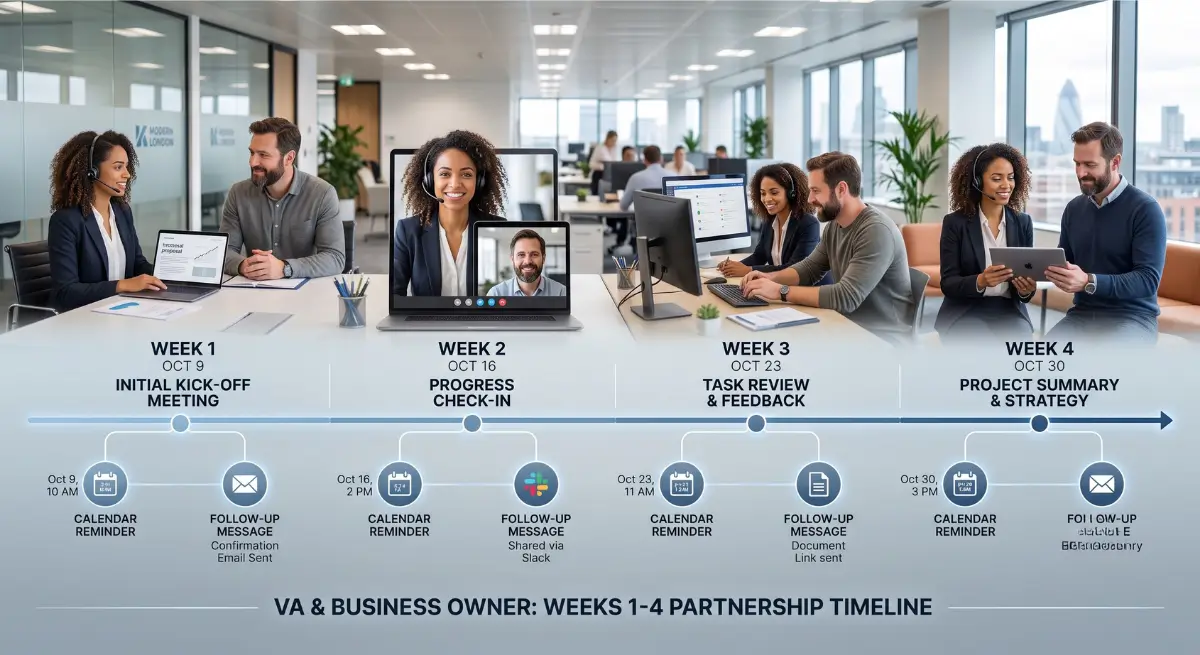
One of the biggest misconceptions in client acquisition is that every conversation should result in an immediate yes.
In reality, many prospects aren’t ready to make a decision straight away.
They may be reviewing budgets.
They may have competing priorities.
They may simply need time.
That doesn’t mean the conversation failed.
It means the relationship is still developing.
The VAs who consistently win clients understand that conversion is often a process, not a single event.
The first conversation creates awareness.
The following conversations build trust.
The eventual decision comes when timing and need align.
This is why follow-up matters so much.
The role of strategic follow-up

Following up doesn’t have to feel awkward.
In fact, when done correctly, it’s one of the most valuable things you can do.
A thoughtful follow-up shows professionalism, reliability, and genuine interest in helping.
The key is to make your follow-up relevant.
Reference something discussed during your original conversation.
Share a useful resource.
Check in on a challenge they mentioned.
Ask whether circumstances have changed.
Simple messages such as:
“Hi Sarah, you mentioned last month that client onboarding was taking up a lot of your time. Just wanted to check in and see how that’s going.”
feel far more natural than:
“Just following up to see if you’re ready to hire me.”
One focuses on the person.
The other focuses on the sale.
Guess which one gets more responses?
Good follow-up keeps relationships warm until the timing is right.
And often, timing is the difference between a prospect and a client.
How to build a repeatable client conversion system

The best client-conversion process isn’t based on memory.
It’s based on systems.
When conversations start increasing, it’s impossible to remember every detail, every follow-up date, and every prospect’s specific challenges.
That’s why successful VAs track their conversations.
Keep notes.
Record key pain points.
Document next actions.
Create reminders for follow-ups.
Whether you use a CRM, spreadsheet, project management tool, or simple tracking system, the principle remains the same:
Every conversation should have a place to live.
When you manage conversations systematically, you stop relying on chance.
You create a repeatable process that turns relationship-building into client acquisition.
The conversation-to-client framework
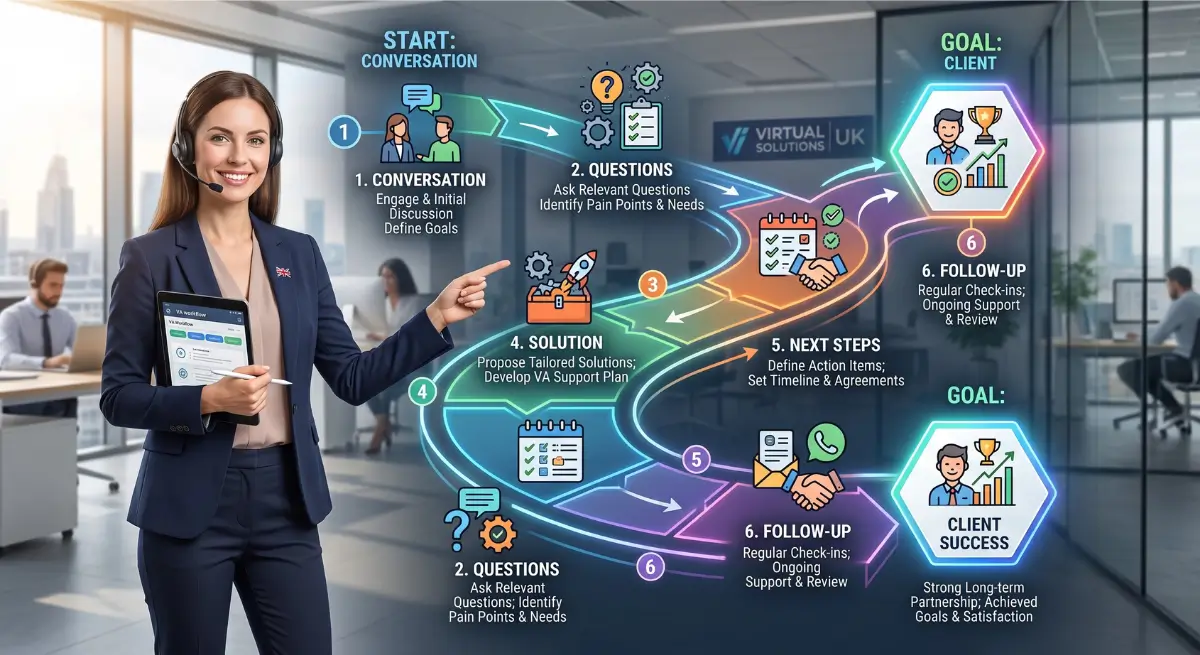
If you remember nothing else from this article, remember this:
Conversations become clients when they follow a clear path.
- Start with a genuine conversation.
- Ask questions that uncover the real problem.
- Show that you understand their situation.
- Offer a helpful insight or perspective.
- Invite the next step.
- Follow up consistently.
- Track the relationship over time.
Simple doesn’t mean ineffective.
In fact, simplicity is often what makes the process work.
Clients don’t want complicated sales funnels or aggressive persuasion.
They want confidence that the person they’re speaking to understands their challenges and can help solve them.
Clients are built through conversations, not pitches

The strongest client relationships rarely begin with a sales pitch.
They begin with a conversation.
A conversation that feels helpful.
A conversation that uncovers a genuine challenge.
A conversation that demonstrates understanding and provides value.
When you stop focusing on selling and start focusing on solving, everything changes.
Prospects become more engaged.
Conversations become more productive.
And client acquisition starts feeling far more natural.
As a Virtual Assistant, your greatest advantage isn’t your ability to persuade someone.
It’s your ability to listen, understand, organise, and support.
Those same skills that make you valuable to clients are the very skills that help turn conversations into clients in the first place.
The next time you start a conversation with a potential client, don’t think about how you’re going to sell.
Think about how you’re going to help.
The clients will often follow naturally.

Take a moment to review your recent conversations with potential clients.
Did you focus on understanding their problem?
Did you offer genuine value?
Did you clearly suggest the next step?
If not, start there.
Small improvements in your conversations can lead to significant improvements in your client conversions.
And often, the difference between a prospect and a paying client is simply one well-managed conversation.
Ready to hire a Virtual Assistant?
If you’re exploring virtual assistant agencies or need guidance on which model fits your business best – now is the time to take the next step.
Let’s find the right support for your workflow, growth, and peace of mind.
The right VA doesn’t just lighten your workload – they protect your momentum.
Why start from scratch when the right team is already trained and ready to plug into your workflow?
Get Started in 3 Easy Steps:
- Book a quick discovery call
- Tell us what your business needs
- Get matched with a trained VA – in days, not weeks
Let’s Build Your Support System
📩 Click here to schedule your consultation
📞 Prefer to talk? Contact us directly at 020 4586 6800
👉 Your next VA shouldn’t just save time – they should unlock growth.
Let’s make that happen. 🚀
Frequently Asked Questions
1. How long does it take to turn a conversation into a client?
There’s no set timeline. Some prospects may be ready to move forward after a single conversation, while others may take weeks or even months. The key is to focus on building trust, understanding their needs, and maintaining consistent follow-up rather than expecting an immediate decision.
2. What should I do if a prospect stops responding?
Don’t assume they’re no longer interested. Business owners are often busy and priorities can shift quickly. Send a polite follow-up that references your previous conversation and offers value rather than asking if they’re ready to hire. Sometimes a simple check-in is enough to restart the conversation.
3. How can I avoid sounding too salesy during client conversations?
Focus on asking questions and understanding the prospect’s challenges instead of promoting your services straight away. When the conversation centres on their needs rather than your offer, it feels more natural, helpful, and authentic.
4. What’s the best next step to suggest after a conversation?
That depends on the prospect’s situation, but common next steps include a discovery call, strategy session, proposal review, or follow-up meeting. The most important thing is to make the next action clear, simple, and relevant to their needs.
5. Do I need a CRM to manage potential clients?
Not necessarily. While a CRM can help as your business grows, a spreadsheet, project management tool, or even a structured note-taking system can work just as well. What’s important is keeping track of conversations, follow-up dates, and key details so opportunities don’t slip through the cracks.